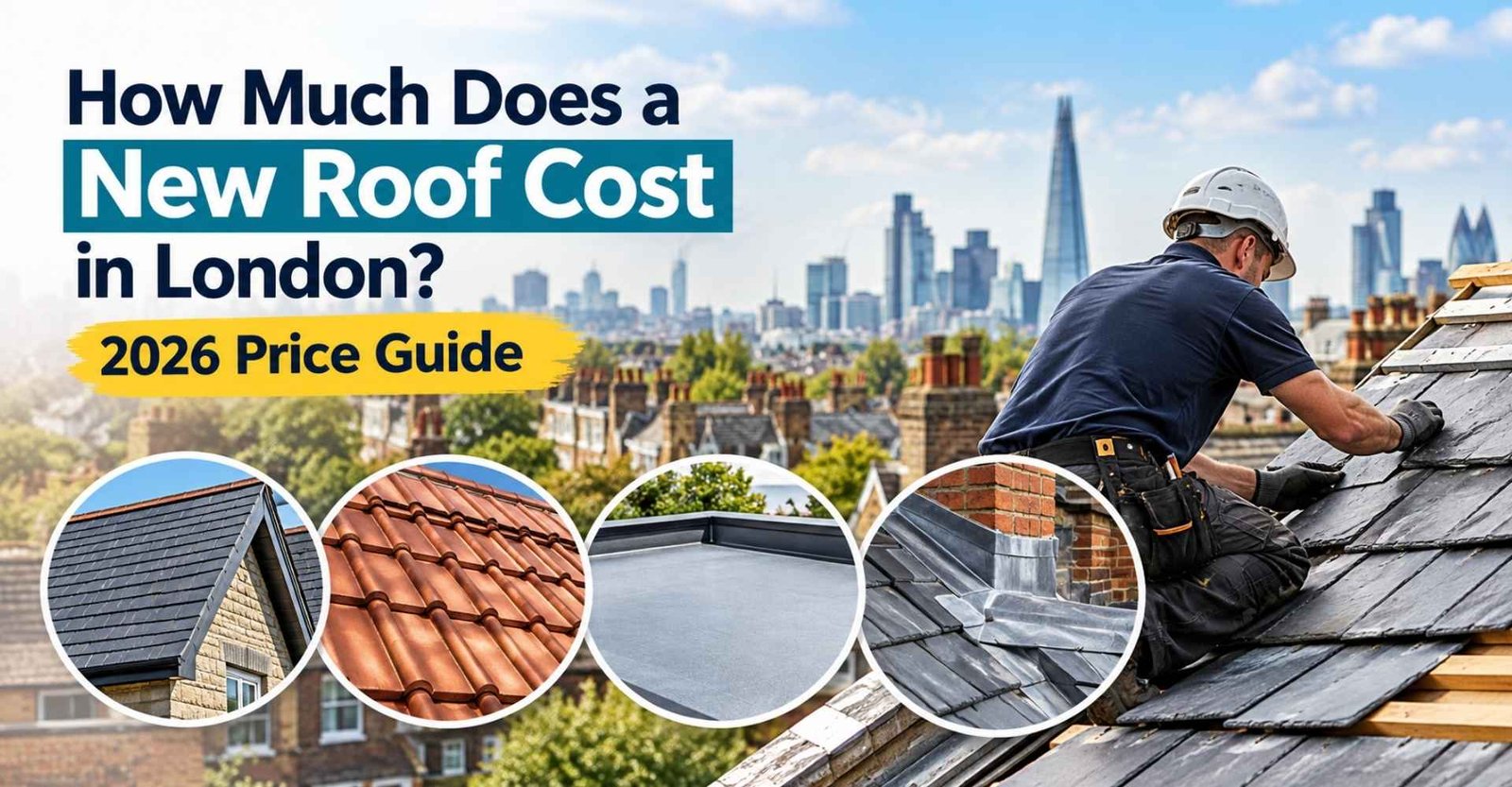
How Much Does a New Roof Cost in London? (2026 Price Guide)
A new roof in London typically costs between £4,500 and £14,000 depending on the roof type, the size of the property, and how easy the roof is to access. A small flat roof extension might come in under £3,000. A full slate re-roof on a three-bed terrace in Ealing or Hayes can run past £15,000 once scaffolding, disposal and any timber repairs are factored in. There’s no single number that applies to every house, but there’s a fairly predictable range for each roof type, and knowing where your job sits in that range makes it much harder for anyone to overcharge you.
This guide breaks down what you can expect to pay by roof type, what pushes a quote up or down, and the extra costs that catch people off guard.
What Actually Drives the Price
Two houses on the same street can get very different quotes for what sounds like the same job, and it’s rarely because one roofer is ripping someone off. A few things move the number more than people expect.
Roof size and pitch. Cost is usually priced per square metre, so a large Victorian roof with multiple valleys and hips costs more than a simple gable roof of the same footprint, even on a smaller house. Steeper pitches also take longer to work on safely, which adds to labour time.
Access. Terraced housing across Hayes, Southall and Uxbridge often means scaffolding has to go up from the front or back with limited space, sometimes needing pavement licences from the council. A detached house with clear access on all sides is usually cheaper to scaffold, which shows up directly in the final price.
Condition underneath the covering. A quote based on a roof inspection from the ground is a guess. Once tiles or slates come off, roofers sometimes find rotten timber battens, damaged felt, or old lead flashing that needs replacing too. This is the single biggest reason final invoices come in above the original estimate, and it’s worth asking upfront how a contractor handles unexpected timber repairs.
Materials. Natural slate costs more than concrete tiles, and clay tiles sit somewhere in between. Reclaimed or heritage-matched materials, often required in conservation areas that cover parts of West London, push costs higher still.
Conservation area and listed building rules. Several pockets of Ealing, Hillingdon and Hounslow fall under conservation area designation, which can mean planning permission is needed for anything visible from the street, including roof material changes. This doesn’t just add cost — it adds time, since council approval can take several weeks.
Slate Roof Cost
Natural slate is the material most associated with older London housing stock, particularly Victorian and Edwardian terraces. A slate roof replacement typically runs £6,000 to £15,000 for an average three-bed terrace, with Welsh slate sitting at the top of that range and Spanish or Chinese slate coming in more affordably without a huge drop in quality.
Repairs are a different story. Replacing a handful of slipped or cracked slates usually costs £150 to £400 for a straightforward job, though anything requiring scaffolding rather than a ladder pushes that up. Slate is durable — a well-maintained slate roof can last 80 to 100 years — so for most West London terraces, targeted repair rather than full replacement is the more common (and more sensible) job.
Full detail on this is on our slate roof repair page.
Tile Roof Cost
Concrete and clay tiles cover most of the 1930s semi-detached housing common across Northolt, Hillingdon and parts of Hayes. Concrete tiles are the cheaper option, with a full re-roof typically costing £4,500 to £9,000. Clay tiles, which have a more traditional look and slightly longer lifespan, usually run £6,000 to £11,000 for the same size property.
Partial repairs — replacing broken tiles after a storm, or fixing a section where the ridge has slipped — are usually in the £200 to £600 range, again depending on access. Ridge tile repointing, a common job on older tiled roofs where the mortar has cracked, typically costs £300 to £800 for a standard-length ridge.
More on the specifics is on our tile roofing page.
Flat Roof Cost
Flat roofs are common on extensions, garages, and the rear additions found on many terraced houses across the service area. Costs vary more here than with pitched roofs because there are three genuinely different systems in common use.
Felt is the cheapest option, typically £60 to £90 per square metre installed, but has the shortest lifespan at 10 to 15 years. GRP (fibreglass) sits in the middle at £80 to £120 per square metre and typically lasts 20 to 25 years with far fewer seams to fail. Liquid membrane systems, often used where a roof has an awkward shape or lots of upstands, run similarly to GRP but can sometimes be applied without removing the existing covering, which saves on labour.
For an average single-storey extension roof (around 20 square metres), that works out to roughly £1,500 for felt, £2,000 to £2,500 for GRP, and £2,000 to £3,000 for liquid membrane, all before scaffolding if the extension isn’t accessible from ground level.
Full breakdown on our flat roofing page.
Loft Conversions: A Different Cost Category Entirely
If a roof problem has you thinking about converting the loft while the roof’s already being worked on, it’s worth knowing this is a separate cost category, not an add-on. A basic rooflight conversion (no structural work, just insulation, flooring and skylights) starts around £15,000. A dormer conversion, which is far more common across the semi-detached housing in this area because it adds proper headroom, typically runs £30,000 to £45,000 depending on size and whether an ensuite is included.
We’ve written a full guide on this separately — see our loft conversions page for the detail, since it deserves more space than a roofing cost guide can give it.
Costs People Forget to Budget For
A handful of costs regularly get left off DIY budget estimates and then show up as a surprise on the final invoice.
Scaffolding. For anything beyond minor repairs reachable by ladder, scaffolding typically adds £700 to £1,500 depending on the size and duration of the hire. Some quotes include this, some don’t — always check.
Skip hire and waste disposal. Old roofing materials, particularly asbestos-containing felt or cement products found on some older flat roofs, need specific disposal. This can add £150 to £400, more if asbestos removal is required.
Guttering and fascias. If a roof is being replaced, it’s often false economy not to replace tired guttering and fascias at the same time, since scaffolding is already up and labour costs are shared. Expect £800 to £2,000 for a full run depending on house size. Details on our guttering and fascias page.
Leadwork. Chimney flashing and valley leadwork are common failure points that inspections sometimes miss until the roof is opened up. Lead repairs typically run £200 to £600 per chimney. See our leadwork page for more.
Building control sign-off. Most roof replacements are notifiable work under building regulations, even when planning permission isn’t needed. A competent contractor will usually handle this through a self-certification scheme, but it’s worth confirming it’s included rather than assuming — the fee, if arranged separately through the local authority, typically runs £150 to £300.
Does the Time of Year Affect the Price?
It can, though not as dramatically as people expect. Late autumn and winter tend to be quieter for roofing contractors, since fewer people want scaffolding up during the wettest months, which occasionally means slightly more room to negotiate on price or timing. Spring and early summer are the busiest months, and booking a slot can take longer simply because crews are stretched across more jobs at once.
The bigger factor is urgency rather than season. A planned re-roof booked a few weeks in advance, with time for materials to be ordered properly, is almost always cheaper than an emergency callout after a storm has already caused damage. Where possible, getting ahead of a problem — booking an inspection when you first notice slipped tiles rather than waiting for a leak — keeps costs on the lower end of these ranges.
How to Get a Quote You Can Actually Trust
The cheapest quote is rarely the best one, and on roofing work specifically, an unusually low price is one of the more reliable warning signs of corners being cut — thinner felt, no breather membrane, or a crew that isn’t fully insured. A few things are worth asking any contractor before agreeing to work:
Whether the quote is fixed or an estimate that could change once the roof is opened up. Whether scaffolding, skip hire and waste disposal are included or separate. What guarantee is offered on both materials and workmanship, and whether that guarantee is backed by an insurance-backed warranty rather than just the contractor’s word. And whether they can show recent, local examples of similar work — a roofer who’s done dozens of Victorian terrace re-roofs in Hayes will spot problems specific to that housing stock faster than a general contractor.
FAQ
How long does a new roof take to install in London?
A straightforward re-roof on a standard terraced house usually takes 5 to 10 working days, weather permitting. Larger or more complex roofs, or ones needing significant timber repair, can take two to three weeks.
Is it cheaper to repair or fully replace a roof?
If less than about 20% of the roof is damaged and the underlying timber is sound, repair is almost always cheaper and the right call. Once damage is more widespread, or the roof covering is past its expected lifespan, full replacement often works out better value over 10+ years than repeated repairs.
Do I need planning permission to replace my roof in London?
Most like-for-like roof replacements don’t need planning permission under permitted development rights. However, if the property is in a conservation area (common across parts of Ealing, Hillingdon and Hounslow) or is a listed building, or if the replacement changes the roof’s appearance or height, permission is usually required.
What’s the cheapest type of roof to install?
Felt flat roofing is the cheapest option per square metre, but it also has the shortest lifespan. For pitched roofs, concrete tiles are cheaper than clay or slate, though the visual difference matters a lot on period properties.
Will home insurance cover any of the cost?
Only if the damage was caused by something insurance covers, like storm damage or a fallen tree, rather than gradual wear and tear. General deterioration from age, which is the cause behind most re-roofing jobs, isn’t something insurance pays for. It’s worth checking your policy before assuming a claim is an option, since a rejected claim can also delay getting the work started.
Should I get more than one quote?
Yes, generally two or three. This isn’t about chasing the lowest number — it’s about sanity-checking that a quote reflects the actual condition of the roof rather than a rushed estimate. Be wary of quotes that are dramatically lower than the others without a clear reason, and equally wary of anyone pushing for a same-day decision.
Get an Accurate Quote for Your Roof
Every roof and every property is different, and the only way to get a number you can actually rely on is a proper inspection rather than a guess from photos. Roof Techies provides free, no-obligation quotes across Hayes and West London for slate, tile and flat roofing, with a fixed price wherever possible so there are no surprises once work starts. Call +44 7414 851249 or use the contact form to arrange a visit.