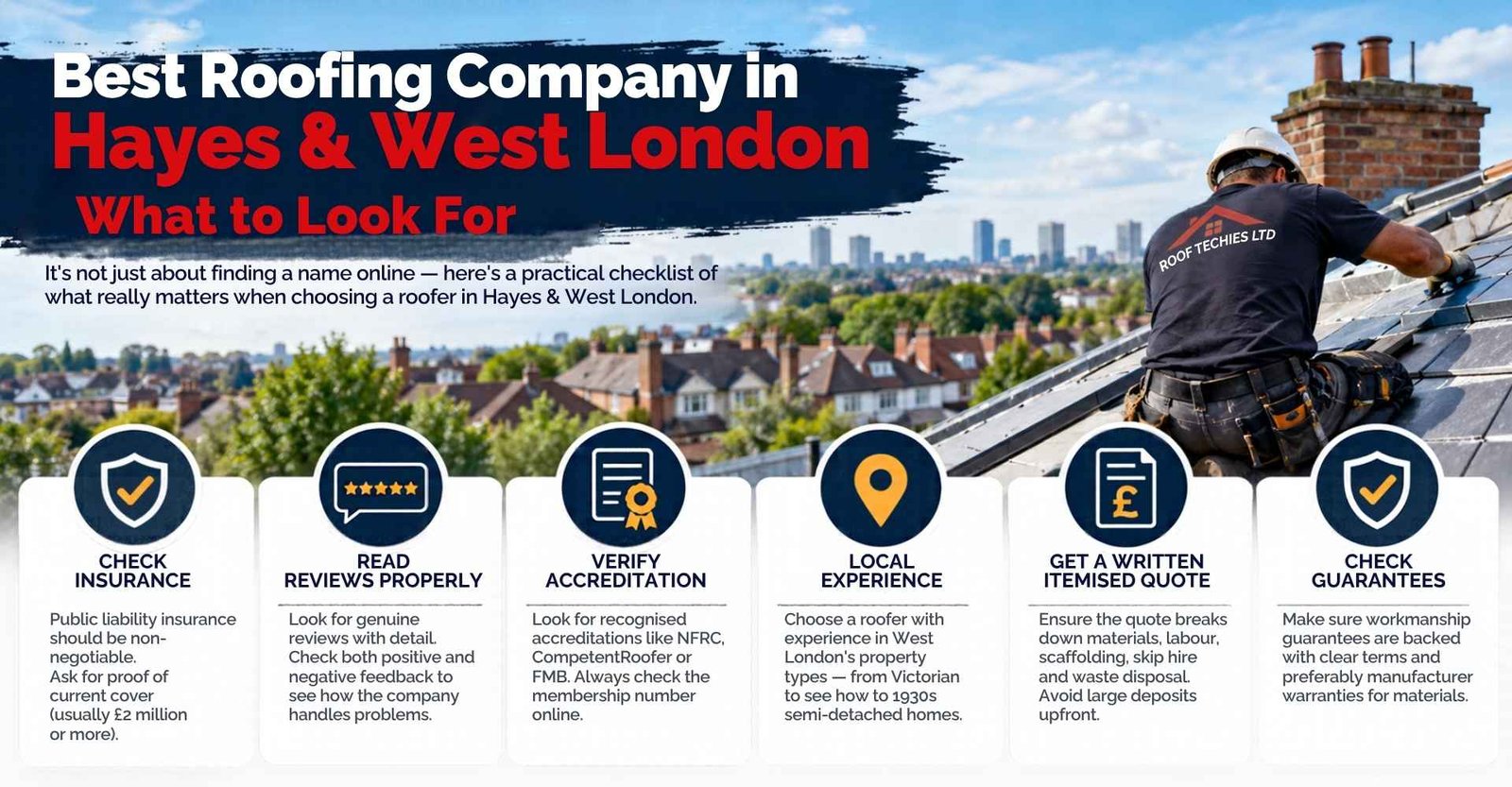
Best Roofing Company in Hayes & West London: What to Look For
Searching “best roofer near me” gets you a list of names, a handful of star ratings, and not much else to go on. Roofing is one of those trades where the difference between a good job and a bad one often isn’t visible until years later, which makes picking the right contractor harder than picking, say, a decorator or a gardener. A bad paint job is obvious within a week. A bad roof job can look fine for two years before it starts leaking.
This isn’t a ranked list of companies — it’s a practical checklist of what actually separates a roofer worth hiring from one worth avoiding, based on the things that matter once the work has started rather than the things that look good in an advert.
Check Insurance Before Anything Else
Public liability insurance should be non-negotiable, not a nice-to-have. Roofing work happens above other people’s property, and above the roofer’s own crew, so the potential cost of an accident — a dropped tool through a car windscreen, a fall, scaffolding damage to a neighbour’s fence — is genuinely high. A legitimate roofing company will have no hesitation providing proof of current cover, usually £2 million or more, and will actually produce it if asked rather than just claiming to have it.
It’s worth asking specifically whether the cover is for the company or for an individual subcontractor, since some roofing work is subcontracted out, and a homeowner can end up dealing with someone whose insurance doesn’t actually match what was promised at the quote stage.
Look at Reviews, But Read Them Properly
Star ratings alone don’t tell you much. A 4.5-star average from three reviews means almost nothing statistically. What matters more is volume and detail — a company with dozens of reviews describing specific jobs (a slate roof repair, a flat roof extension, a gutter replacement) gives you a much clearer picture than a handful of generic five-star ratings with no detail behind them.
It’s also worth reading a couple of the lower-scored reviews, if any exist, and seeing how the company responded. A reasonable, non-defensive response to a fair complaint tells you more about how a company handles problems than a wall of five-star reviews ever will, since every roofing job runs into at least the occasional hiccup — weather delays, a supplier running late — and how that gets communicated matters.
Accreditation Should Be Specific, Not Vague
“Accredited” on its own means very little unless you know accredited by whom. Genuine trade accreditations worth looking for include NFRC (National Federation of Roofing Contractors) membership, CompetentRoofer scheme registration (which allows self-certification of building regulations compliance for roof work), or FMB (Federation of Master Builders) membership. Any of these involve some level of vetting, and most come with an accessible online directory where you can actually verify a company’s membership number rather than taking the claim at face value.
If a company’s website mentions being “fully accredited” without naming the body, it’s a fair question to ask directly — and a reasonable one to be cautious about if the answer is vague.
Local Experience Actually Matters Here
West London’s housing stock isn’t uniform, and it makes a real difference whether a roofer has worked extensively on the specific types of property common in this area. Victorian and Edwardian terraces around Ealing and Southall have particular quirks — original slate roofs, older chimney stacks, valley gutters that need specific know-how to repair properly. The 1930s semi-detached housing common across Northolt and Hillingdon tends to have hip roofs with different tile patterns and different common failure points.
A roofer who works across a wide area and a wide range of property types tends to spot problems faster and price more accurately than one working from a generic template, simply because they’ve seen the specific issue before. It also means fewer surprises once work is underway — a contractor who’s already dealt with the original lath-and-plaster ceilings common in older Ealing terraces, for instance, knows to protect them differently during internal access than they would in a modern extension.
Get a Written, Itemised Quote
A trustworthy quote breaks down what’s included — materials, labour, scaffolding, skip hire, waste disposal — rather than presenting one lump figure. This matters for two reasons. First, it lets you actually compare quotes from different companies on a like-for-like basis rather than guessing what’s included in each. Second, it protects you from scope creep, where extra costs get added mid-job that weren’t clearly excluded from the original number.
Be cautious of quotes that require a large deposit upfront, particularly anything over 25-30% of the total job value before work has started. Reputable contractors typically stage payments against progress, not against promises.
Guarantees Should Be Backed, Not Just Promised
A workmanship guarantee is only as good as what stands behind it. Ask specifically whether the guarantee is insurance-backed, meaning it’s protected even if the company itself later closes down, or whether it’s simply the company’s word. Insurance-backed guarantees, often arranged through schemes like Checkatrade Insurance Backed Guarantees or similar, cost a company more to offer, which is itself a reasonable signal that they’re confident in their own work.
Materials typically carry their own manufacturer warranty separate from the workmanship guarantee — it’s worth understanding which is which, since a material fault and an installation fault are covered differently.
Response Time Says a Lot
How quickly a company responds to an initial enquiry, and how clearly they communicate during that first contact, is a reasonable proxy for how they’ll communicate once they’re on site and something needs a decision quickly — a hidden timber problem found once tiles come off, for instance. A company that takes a week to reply to a quote request and then goes quiet mid-job is a genuinely common complaint, and it’s one of the few things you can actually gauge before hiring anyone.
A Local Portfolio Beats a Generic Stock Photo Gallery
Photos of actual completed jobs, ideally with some context about what the job involved, are worth more than a polished set of stock imagery. A gallery showing real slate repairs, real flat roof extensions, real guttering jobs across recognisable local housing gives a much better sense of what you’ll actually get than a website full of generic roofing photography that could belong to any company anywhere.
Red Flags Worth Walking Away From
Alongside what to look for, a few patterns are worth treating as genuine warning signs rather than minor quirks.
Unsolicited cold calls or doorstep offers, especially ones claiming to have “noticed damage” while working on a neighbour’s roof, are a long-running scam pattern in the trade. A legitimate roofer doesn’t need to drum up business by knocking on doors claiming urgent damage they happened to spot from the street.
Pressure to decide immediately, particularly combined with a “special discount today only,” is a sales tactic borrowed from far less reputable industries and has no real place in roofing. A genuine quote holds for at least a couple of weeks — there’s no legitimate reason a fair price needs a same-day yes.
Cash-only payment with no invoice removes any paper trail if something goes wrong later, and it also means there’s no formal record for any guarantee to attach to. A proper invoice isn’t bureaucracy for its own sake — it’s what a workmanship guarantee is actually built on.
No fixed business address or landline, only a mobile number and no verifiable trading address, makes it much harder to hold a company accountable if a dispute arises after the job’s finished. It doesn’t automatically mean the work will be bad, but it removes a layer of accountability that a properly established local company has by default.
Reluctance to put anything in writing, whether that’s the quote itself, the guarantee terms, or the payment schedule, is one of the clearest signals to be cautious. Verbal promises are hard to enforce, and a company confident in its own work has no real reason to avoid writing it down.
Where Roof Techies Fits Into This
We’d rather you use this checklist against us the same way you’d use it against anyone else. Roof Techies is based in Hayes and holds a 4.9-star rating from 56 reviews on Google, covering jobs across slate and tile roofing, flat roof installation, loft conversions, guttering and leadwork. We’re fully insured, and we provide written, itemised quotes before any work starts — no lump-sum guessing.
Our crew works across Hayes, Uxbridge, Southall, Northolt, Hillingdon and the surrounding West London area, on the property types common to this part of London specifically, rather than as a generalist contractor covering all of Greater London thinly. You can see examples of completed work on our gallery page, and more about the team on our About Us page.
FAQ
How do I verify a roofer’s insurance is genuine?
Ask for the insurer’s name and policy number, then contact the insurer directly to confirm cover is active. A legitimate contractor won’t mind this level of checking.
Is the cheapest quote ever the right choice?
Occasionally, but it’s the exception rather than the rule. An unusually low quote compared to others for the same job is one of the more reliable warning signs that something’s being cut — insurance, material quality, or proper waste disposal.
How many quotes should I get before deciding?
Two or three is generally enough to sanity-check pricing and get a feel for how different companies communicate, without dragging the process out for weeks.
What’s the difference between a guarantee and a warranty?
A guarantee typically covers workmanship — the quality of the installation itself. A warranty usually covers materials, provided by the manufacturer rather than the installer. Both matter, and they’re not the same thing.
Should I worry if a roofer can’t start for a few weeks?
Not necessarily — busy periods (spring and early summer especially) mean good local roofers are often booked ahead. A longer lead time is more often a sign of demand than a red flag, provided the timeline is communicated clearly upfront.
Is a company’s location important if the work quality is the same?
It affects more than convenience. A company based locally knows the specific council rules around scaffolding permits, conservation area restrictions, and the housing stock quirks in the immediate area — knowledge that a contractor travelling in from further afield often doesn’t have.
Get a Free, No-Obligation Quote
If you’re comparing roofers in Hayes or West London, we’re happy to be one of the quotes you get. Call +44 7414 851249 or use the contact form to arrange a free inspection and a written quote — no pressure, no rushed decisions.