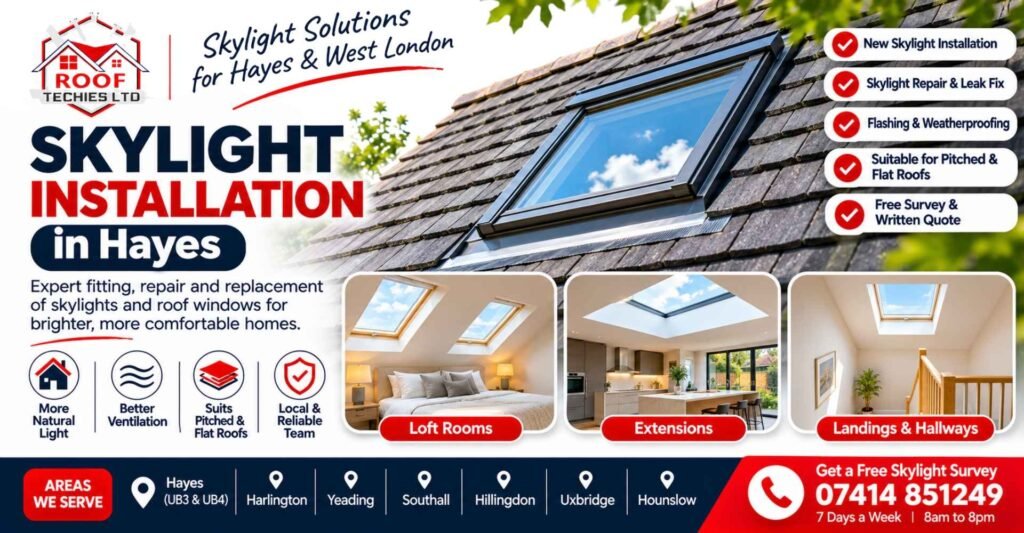

Skylight Installation West London | Roof Techies
Skylight installation in Hayes means fitting a roof window or roof light into the roof, cutting and framing the opening, flashing it correctly and linking it to the surrounding tiles, slates or flat roof covering. A skylight can brighten a loft, landing, kitchen or bathroom for decades. It can also become one of the most common sources of roof leaks in a house if the flashing is poor. This guide explains the types of skylight, how installation is carried out, what affects the cost and how to avoid the mistakes that cause leaks.
What a skylight does for a room
A skylight lets daylight in from above. Because the light comes from the roof, a roof window can light a room that has little wall space for a conventional window, such as a loft bedroom, a landing or a kitchen extension. Light from above also reaches deeper into a room than light from a side window. A skylight can also provide ventilation, if it opens, which is useful in rooms that get warm or damp.
The trade-off is heat and sealing. A roof window loses more heat than a well-insulated wall, so the glazing and frame matter. Overheating is a risk on south- and west-facing roofs, so the glass specification and any blinds should be chosen with the orientation in mind.
Types of skylight
Pitched roof windows
Pitched roof windows fit into tiled, slate or metal roofs. They are the most common type and include the widely known Velux-style window. Many open to ventilate the room and can be fitted with blinds, shutters or electric controls. They sit flush with the roof slope and are flashed with a kit or lead.
Fixed roof lights
Fixed roof lights do not open. They are simpler, often less expensive and give a clean look. They suit rooms that need light but not ventilation, such as a stairwell, landing or bathroom with an extractor fan.
Flat roof lights and lanterns
Flat roof lights and lanterns sit on a raised kerb on a flat or low-pitched roof. They are common above kitchens, extensions and stairs. The kerb keeps water away from the glass, and the joint between the kerb and the roof covering must be sealed carefully. Flat roof lights are often fitted at the same time as the roof covering, but they can also be replaced in an existing roof.
Conservation-style windows
Conservation-style roof windows have a flush frame and a low profile. They suit period homes and conservation areas where the appearance of the roof matters. They can be more expensive, and the planning position should be checked where the property is in a conservation area.
The installation process
A typical installation follows a set sequence:
1. Survey. The roof pitch, covering material, rafter spacing and the room below are checked.
2. Choosing the window. Size, opening type and glazing are chosen to suit the room and the roof.
3. Opening the roof. Rafters are cut and framed, with the correct header support.
4. Fitting the window. The frame is set into the opening and secured.
5. Flashing. Lead, metal or a flashing kit is fitted so water runs away from the frame.
6. Connecting to the roof. Tiles or slates are re-laid around the window and lapped correctly.
7. Finishing. The lining, trim and any blinds are fitted inside.
The most important stage is flashing. A skylight with the right window but poor flashing will leak, and a leak is often blamed on the window when the fault lies in the apron or the sides.
Choosing the right size and position
The best position depends on the roof and the room. A window high on the slope gives the most light to the room below, but it can be harder to reach for cleaning. A window lower on the slope gives views and light for a standing-height room, but may reduce privacy. Several windows can light a long or deep room, but each one needs careful framing and flashing. Ask the installer how the window sits against the rafters before the position is agreed.
Leak prevention
Most skylight leaks come from flashing, not from the window itself. Good installation includes:
- The correct flashing kit or lead for the roof covering and pitch
- Lead or metal aprons at the top and sides where the window meets the roof
- Proper tile or slate lapping around the frame
- A seal tested after the work is finished
If you already have a leaking skylight, the fix is often new flashing rather than a new window. We check the flashing first. Our leadwork service covers this in one visit where needed.
Repair or replacement
Repair is usually the first step for a leak around the frame, a misted or cracked double-glazed unit, a stuck opening mechanism or rotten trim. Replacement is worth considering when the window is old, the seals have failed or the window no longer suits the room. A like-for-like replacement often keeps the surrounding roof intact. A larger opening needs more structural work.
Building regulations and planning
Roof windows in habitable rooms usually need building regulations approval, covering escape, ventilation and thermal performance. Planning permission is not normally needed for a standard roof window on a house, but conservation areas and listed buildings have stricter rules. Check with your council before work starts.
What affects the cost
The main factors are the window type and size, the roof covering, the number of windows, the flashing work and any structural changes. A single fixed roof light on an accessible roof costs far less than several electric openers in a steep heritage roof. A written quote should list each window, the flashing and the finish separately.
Frequently asked questions
Can a skylight be fitted to any roof?
Most pitched roofs can take a roof window, but the covering, pitch and rafter layout decide the best product and position. We check these before recommending a window.
Will a skylight leak?
A correctly fitted skylight with the right flashing should not leak. Most problems come from flashing or failed seals, which can be repaired.
How long does skylight installation take?
A single window in a standard roof is often fitted in a day. Several windows, structural changes or flat roof lights take longer.
Do skylights need planning permission?
Standard roof windows on houses usually do not. Conservation areas and listed buildings have stricter rules, and building regulations usually apply to habitable rooms.
Can an old skylight be replaced without a new roof?
Often yes, if the surrounding tiles or slates and the flashing are sound.
Get a free skylight quote in Hayes
Phone 07414 851249, 7 days, 8am to 8pm. Serving Hayes UB3 and UB4, Harlington, Yeading, Southall, Hillingdon, Uxbridge and Hounslow. See our skylights service page.