What are fascias, soffits, and gutters — and why do they matter?
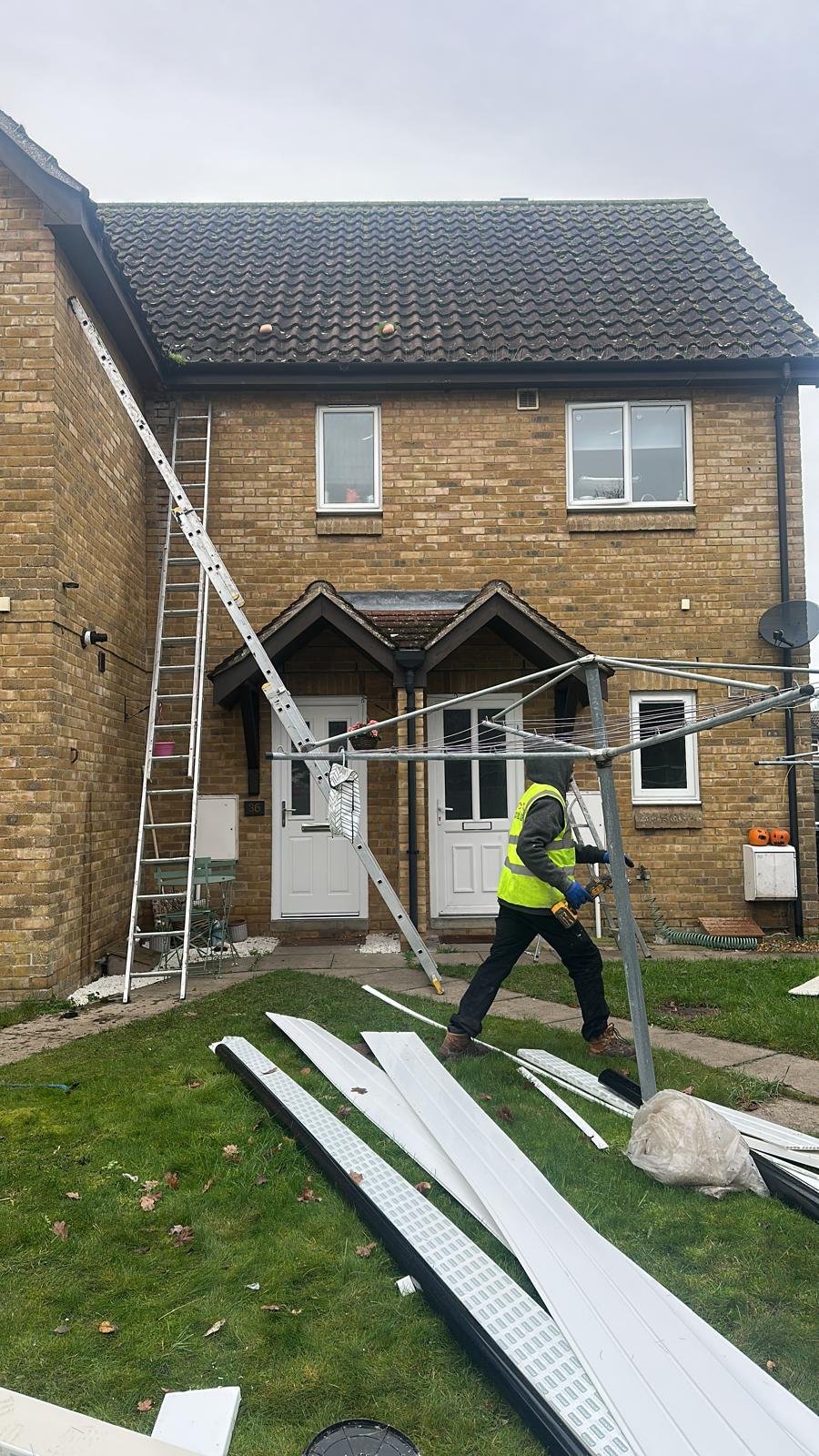
The roofline of a property — the collective term for the fascias, soffits, and rainwater goods at the eaves — performs a role that is easily underestimated until it fails. Fascias are the vertical boards fixed to the ends of the roof rafters, running horizontally along the eaves. Soffits are the horizontal boards that fill the gap between the fascia and the outer wall of the building, closing off the underside of the roof overhang. Gutters and downpipes are fixed to the fascia board and carry rainwater away from the roof surface and building footprint.
Together, these elements protect the roof structure from water penetration at the eaves, ventilate the roof space to prevent condensation, provide the substrate to which gutters are fixed, and determine the visual character of the building at eaves level. When any one of them fails, the consequences cascade: a rotting fascia board compromises the fixing of the gutter; a sagging gutter overflows and directs water against the wall; water penetrating behind the fascia reaches the wall plate and roof structure, causing damp and rot that can be expensive to remedy.
For the West London housing stock — where significant numbers of properties still have original timber fascias, either bare wood or painted, from the original construction — UPVC roofline replacement has become one of the most practical and cost-effective home maintenance investments available.
Signs that your fascias and soffits need replacing
Visible rot is the most obvious indicator. Painted timber fascias that are soft to touch, showing surface cracking, blistering paint, or black staining, are retaining moisture and the wood beneath the surface is deteriorating. Once rot is established in timber fascias, painting over it does not stop the progression — it merely hides the problem temporarily while the rot continues beneath.
Gutter pull-down is a practical warning sign that the fascia board behind the gutter has rotted sufficiently to no longer support the fixing. When a gutter sags away from the fascia, it is usually because the screw fixing has pulled through deteriorated timber. This is a safety risk as well as a functional failure — a full length of loaded gutter falling from eaves height is a significant hazard.
Staining on external walls directly below the gutterline — particularly vertical green or black streaking — indicates that gutters are overflowing or have broken joints that are directing water against the wall face. Left unaddressed, persistent wall wetting leads to dampness internally and, on cavity wall construction, risks water bridging the cavity.
In the loft, brown staining on the underside of the roof deck near the eaves, or insulation that is wet within 500mm of the eaves, indicates that water is getting behind the fascia and finding a route into the roof structure. This is the stage at which the damage has progressed from cosmetic to structural, and urgency increases.
UPVC vs timber fascias — why UPVC wins for most West London homes
The case for UPVC fascias over timber on standard residential properties in West London is straightforward. UPVC does not rot, does not need painting, does not absorb moisture, and does not attract insects or fungi. In the West London climate — moderate rainfall, temperature swings from below zero in winter to above 30°C in summer — the expansion and contraction that causes timber fascias to crack, lift joints, and open gaps for water ingress is a genuinely significant maintenance burden. UPVC handles these temperature swings with designed-in expansion joints that keep the material stable.
Modern UPVC roofline products are available in a wide range of colours, sizes, and profiles — including foil-wrapped products that accurately mimic the appearance of painted timber for use on period properties or in conservation areas where the visual character of the roofline matters. The initial cost of UPVC replacement is typically higher than repainting timber, but the whole-life cost is dramatically lower given the elimination of five-to-seven-year repainting cycles.
For properties where the fascia board is structurally sound and paint maintenance is feasible, timber can remain a viable choice. But for the large proportion of West London semi-detached and terraced homes where the existing timber fascias are fifty to seventy years old and showing signs of deterioration, UPVC replacement represents a definitive solution rather than an ongoing maintenance task.
Gutter systems — standard sectional vs seamless guttering
Standard sectional guttering — the type available at DIY retailers in 2-metre or 4-metre lengths — is joined at regular intervals by connectors and stop ends. These joints are sealed with rubber gaskets that are the primary failure point over time. As gaskets harden with age and UV exposure, they lose their seal, and leaking joints begin to drip water behind the fascia or down the wall face.
Seamless guttering is made on-site using a roll-forming machine that extrudes continuous aluminium gutter in exactly the right length for each run, with joints only at corners, outlets, and stop ends. This dramatically reduces the number of potential leak points and produces a cleaner, more architecturally considered appearance than sectional guttering with its visible regular joints.
Seamless aluminium guttering is factory-coated in a polyester powder finish in a range of RAL colours and requires no maintenance beyond periodic cleaning. It is significantly more resistant to corrosion than steel and more dimensionally stable than PVC in temperature extremes. For new roofline installations or full replacements, seamless aluminium guttering is increasingly the preferred choice among homeowners who want a long-term, low-maintenance solution.
Guttering maintenance and cleaning — what West London homeowners need to do
Gutters in West London, where deciduous street trees are abundant, accumulate leaf and organic debris rapidly — particularly between October and December. A gutter that was functioning correctly in September can be fully blocked by early November, causing overflow that directs significant volumes of water against the building fabric during the wettest months of the year.
Professional gutter cleaning should be carried out at minimum once per year — ideally in November after leaf fall is complete — and ideally twice per year if there are trees directly overhanging or adjacent to the roof. A professional clean includes clearing the gutter channel, checking for and clearing blockages at downpipe heads and within the downpipes themselves, and flushing the run with water to verify clear drainage.
Gutter guards — mesh products installed in the gutter channel to exclude leaves while allowing water to pass — can reduce cleaning frequency but do not eliminate it. Fine organic material and moss still accumulates on and beneath most guard products, and periodic checking and clearing is still required. For comprehensive gutter maintenance guidance, our roof cleaning West London service includes gutter inspection and clearance as standard.
Roofline replacement costs in West London — 2026 guide
UPVC fascia, soffit, and guttering replacement costs vary depending on property size, height, number of elevations, and ease of access. The following ranges apply to typical West London semi-detached and terraced properties in 2026.
A standard semi-detached property with a two-elevation roofline — front and rear — typically costs between £1,500 and £3,000 for a full UPVC fascia, soffit, and gutter replacement. This includes stripping the existing roofline, inspecting the rafter feet and wall plate, fitting UPVC over-fascia board or direct replacement, fitting UPVC soffit with ventilation inserts, and installing new PVC sectional or aluminium seamless guttering.
A detached property with four elevations typically costs between £2,500 and £5,000 depending on size and height. Properties where access requires scaffolding — typically any elevation above 5m high or where ladder access is obstructed by an extension or conservatory — incur additional scaffold costs. Individual gutter repairs — replacing a broken joint, re-fixing a dropping bracket, or replacing a cracked gutter section — typically cost £80 to £200 per repair depending on access. These smaller repairs are worth addressing promptly to prevent the progressive wall wetting that makes a small gutter problem into a larger structural damp issue.
Frequently asked questions — fascias soffits guttering West London
Q: Do I need scaffolding to replace fascias and soffits?
On most two-storey properties, ladder access with a standoff is sufficient for fascia and soffit work on the front and rear elevations. Three-storey properties and any elevation where ladder access is obstructed will typically require scaffolding or a mobile elevated work platform.
Q: Can UPVC fascias be installed over existing timber?
Yes — in many cases, UPVC over-fascia capping can be installed over existing timber fascias that are structurally sound, avoiding the need to remove the existing board. This reduces labour cost but should only be done when the timber beneath is confirmed dry and structurally intact, as capping over rotten timber traps moisture and accelerates deterioration.
Q: Why is my gutter overflowing when it is not blocked?
An unblocked gutter that overflows in heavy rain is usually either undersized for the catchment area of the roof, incorrectly pitched so that it slopes towards the middle rather than the outlet, or has sunk on its brackets over time. A correctly installed gutter should fall at approximately 1:600 gradient towards the outlet.
Q: How long does UPVC last before it needs replacing?
Quality UPVC roofline products have a manufacturer life expectancy of 25 to 30 years. In practice, well-installed UPVC fascias and soffits regularly perform for 30 to 40 years without significant issues, making them a genuinely long-term solution rather than a short-term fix.