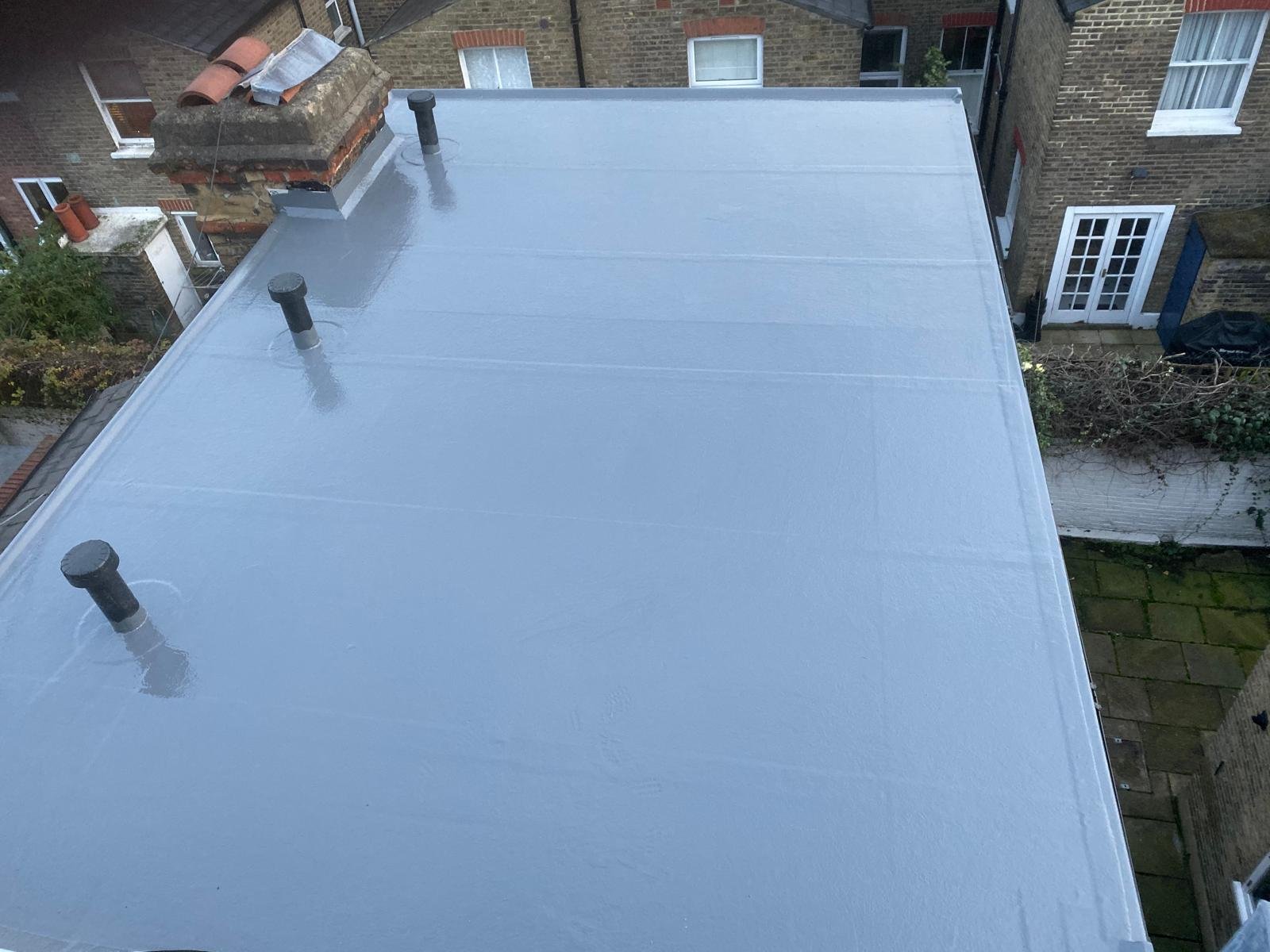
What is liquid roofing and why is it transforming flat roof solutions in West London?
Liquid roofing refers to a category of flat roof waterproofing systems in which a coating material is applied in liquid form to the roof surface and cures — chemically or through solvent evaporation — to form a fully bonded, seamless waterproof membrane. Unlike traditional felt, GRP, or single-ply sheet membranes, liquid systems have no seams, joins, or overlaps across their cured surface, eliminating the primary failure points of conventional flat roofing.
The liquid roofing market in the UK has grown substantially over the past decade, driven by the development of high-performance polyurethane (PU) and Polymethyl Methacrylate (PMMA) systems that deliver 20 to 30-year lifespans, fast cure times, and application flexibility that sheet systems cannot match. For the West London market — where the housing stock includes a large number of flat-roof rear extensions, garage roofs, and commercial outbuildings — liquid roofing has become the go-to choice for refurbishment projects where disruption needs to be minimised.
This guide explains how liquid roofing systems work, compares the main system types available in 2026, covers the application process, and helps West London homeowners and commercial property owners determine whether a liquid system is right for their specific roof.
How liquid roofing systems work
All liquid roofing systems share the same fundamental principle: a reactive liquid compound is applied to a prepared roof surface where it cross-links chemically to form a tough, elastic polymer membrane. The resulting membrane is fully bonded to the substrate beneath, which eliminates the risk of water tracking laterally beneath the membrane — a significant failure mode in poorly-bonded sheet systems.
The seamlessness of liquid membranes is their most practically significant quality. Any detail — a roof penetration, a drainage outlet, a complex parapet junction, a skylight upstand — can be waterproofed with the same material and to the same standard as the main roof field. The contractor tools around every detail with the same liquid compound, building up thickness at critical points using reinforcement fleece. The result is a fully integrated, monolithic waterproof layer rather than a series of components with junctions between them.
Cure time varies by system type. PMMA (acrylic) systems are cold-applied and cure in fifteen to sixty minutes even in low temperatures — making them the preferred choice for time-critical projects or those being carried out in autumn and winter when other systems struggle with temperature constraints. PU systems typically require overnight cure before the next coat can be applied, but offer excellent long-term elasticity and a high-quality aesthetic finish.
Types of liquid roofing systems available in West London
Three main liquid roofing system types are commonly specified for West London projects: polyurethane (PU), PMMA acrylic, and liquid EPDM rubber.
Polyurethane (PU) liquid roofing
PU systems are the most widely used liquid roofing specification in the UK residential market. Applied in two or three coats over a primer and reinforcement fleece at critical details, a PU liquid roof delivers elongation of 300–500% before failure — meaning the membrane can absorb significant structural movement without cracking. PU systems carry typical system guarantees of 15–25 years from the major manufacturers and are suitable for roofs over habitable spaces, extensions, and flat-roof areas that require a clean, smooth finish.
PU is the system most commonly specified for residential rear extensions across Hayes, Ealing, and Hillingdon, and it is the primary liquid system Roof Techies installs for West London homeowners. Its cure time of six to twelve hours per coat requires that work is carried out in dry conditions above 5°C, which is generally manageable in West London for all but the coldest and wettest months.
PMMA acrylic liquid roofing
PMMA systems use a two-component acrylic resin that is catalysed on site and cures in fifteen to forty-five minutes regardless of temperature. This rapid cure makes PMMA the preferred choice for time-critical refurbishment projects — a roof that must be waterproofed between weather windows on a single day — and for winter installations when PU cure times are impractical.
PMMA systems deliver excellent chemical resistance, outstanding UV stability, and a very smooth finish. The working time is short, requiring experienced contractors who can handle the material efficiently, and the system is generally more expensive than PU. For commercial projects and refurbishments on occupied buildings where speed of installation is a priority, PMMA is a justified premium.
Liquid EPDM rubber
Liquid EPDM is a single-component water-based rubber coating that cures at ambient temperature to form a flexible EPDM-like membrane. It is generally specified for repairs and maintenance coatings over existing flat roofing rather than full system installations, and its elongation and chemical resistance are lower than PU or PMMA. For small repair areas, maintenance over aging felt, or temporary weatherproofing situations, liquid EPDM can be a cost-effective and accessible option.
Liquid roofing for refurbishment — the overlay advantage
One of the most significant advantages of liquid roofing systems over sheet membrane replacements is their suitability for overlay refurbishment — applying the new waterproofing layer directly over the existing roof surface without stripping and replacing the deck. This approach is possible when: the existing membrane is still structurally bonded to the deck; there is no evidence of moisture within the existing build-up; and the existing surface is compatible with the liquid system primer.
When these conditions are met, liquid overlay refurbishment can reduce project cost by 30–50% compared to a strip-and-replace approach, dramatically reduce the disruption to the building interior (no stripping, no open deck, no debris), and be completed in a fraction of the time. For commercial buildings and occupied residential properties, this difference is highly significant.
Before any overlay is specified, a moisture survey of the existing roof build-up is essential. Electronic impedance meters or infrared thermographic surveys can identify areas of moisture-laden insulation beneath the existing membrane. Any wet areas must be stripped and dried before the overlay is applied — applying a bonded waterproof membrane over saturated insulation traps moisture that cannot evaporate, leading to system delamination and guaranteed early failure.
Liquid roofing for commercial properties in West London
West London has a significant commercial property stock — industrial estates in Hayes, Southall, and Park Royal; office buildings in Uxbridge; retail developments across Ealing and Hounslow — and many of these properties have large flat roofs that are overdue for refurbishment. Commercial liquid roofing is a specialist market segment with its own specification requirements, and Roof Techies has experience carrying out liquid roofing installations on commercial and industrial buildings throughout the area.
For commercial roofs, the key considerations are: the area to be waterproofed (larger roofs require more material and longer programme times); access and working-at-height management; the impact of rooftop plant, drainage outlets, and other penetrations on the installation; and the commercial urgency of a weatherproof result.
Commercial liquid roofing projects typically benefit from a formal specification document — often prepared by a building surveyor or roofing consultant — that details the system to be installed, the preparation requirements, the minimum application rates, and the inspection and testing protocol. This formal specification protects the building owner and forms the basis of any system guarantee issued by the manufacturer.
Liquid roof repair — targeted solutions for leaking flat roofs
Not every liquid roofing project requires a full system installation. Where an existing flat roof — whether felt, GRP, or a previous liquid coating — has a localised failure such as a cracked joint, a blistered area, or a failed detail around a drain or penetration, targeted liquid repair can address the specific problem without replacing the entire roof.
Liquid repair systems are applied to the cleaned and prepared failure area, bonding to the existing substrate and bridging the defect. For GRP roofs with edge cracking, for felt roofs with failed lap joints, and for aging liquid systems where a specific detail has deteriorated ahead of the main field, a targeted repair using a compatible liquid system can add five to ten years of further service to an otherwise sound roof.
The key to successful liquid repair is proper preparation and compatibility assessment. A repair material that bonds poorly to the existing substrate — either because the substrate is contaminated or because chemically incompatible materials are combined — will fail in the same location in months rather than years. An experienced liquid roofing contractor will assess substrate compatibility before specifying the repair system.
Frequently asked questions — liquid roofing West London
Q: How long does liquid roofing take to install?
A standard single-storey rear extension (15–25m²) can typically be completed in one to two days for a PU system — primer on day one, reinforcement and first liquid coat, then topcoat on day two. PMMA systems can sometimes be completed within a single working day due to the rapid cure time.
Q: Can liquid roofing be applied in cold weather?
PU systems require temperatures above 5°C and dry conditions. PMMA systems can be applied at lower temperatures and cure very quickly, making them the preferred choice for winter installations. Always check manufacturer guidance for specific temperature and humidity requirements.
Q: Is liquid roofing more expensive than felt?
A quality liquid roofing system is typically 20–40% more expensive than a modified felt installation on the same roof area. However, the 20–30 year system guarantee and superior flexibility and seamlessness of liquid systems deliver significantly better whole-life value than repeated felt replacements.
Q: Can I apply liquid roofing myself as a DIY project?
Some liquid EPDM products are marketed as DIY-applicable, and small repair applications are technically possible for competent homeowners. Full system installations — particularly PU and PMMA systems — require specialist training, mixing equipment, and application experience to achieve the correct film build and cure profile. An incorrectly installed liquid system is no better than a correctly installed felt system, and a manufacturer guarantee is conditional on professional installation.