Tiled roofs in West London — the dominant roofing material
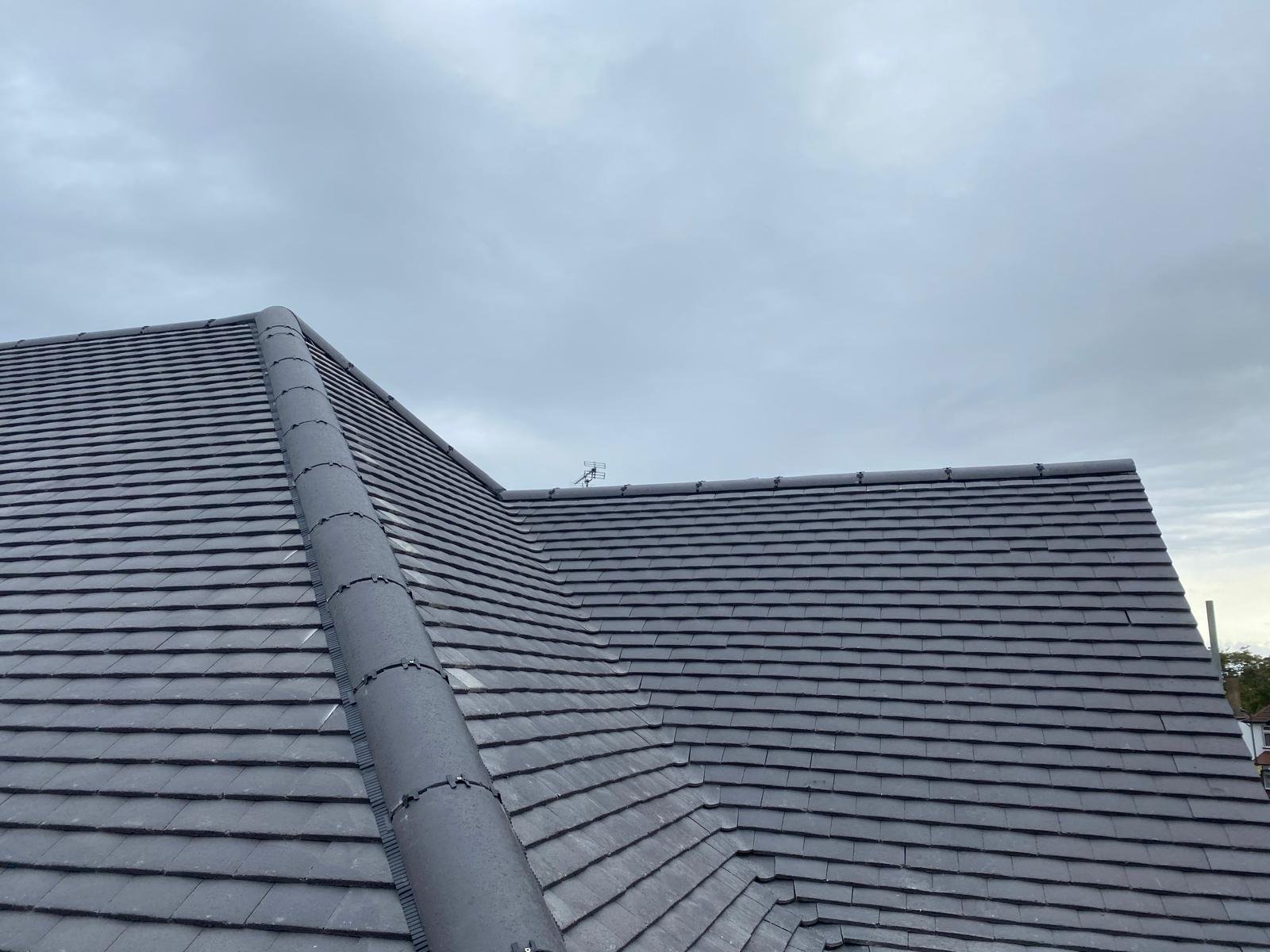
Tiled roofing covers the majority of residential properties in West London. From the interwar semi-detached homes of Hayes, Southall, and Ealing — typically covered with concrete interlocking tiles installed in the 1960s or 1970s — to the Victorian terraces of Brentford and Isleworth with their original clay plain tiles, tiled roofs represent the primary roofing challenge that West London contractors face. Understanding the differences between tile types, the common failure modes, and the options for repair versus replacement is essential knowledge for any homeowner managing a tiled property.
Unlike slate, which when properly fixed tends to last 80 to 150 years, clay and concrete tiles have more variable lifespans that depend heavily on specification, installation quality, and maintenance. Post-war concrete tiles — particularly the profiles installed in mass housebuilding from the 1950s to the 1980s — are now reaching the end of their designed service life on many West London properties, and the question of repair or replacement is becoming increasingly pressing for homeowners across the borough.
Clay tiles vs concrete tiles — key differences for West London homeowners
Clay and concrete roof tiles share the same function but differ significantly in their physical properties, appearance, longevity, and cost. Understanding these differences helps homeowners make better decisions when choosing replacement tiles or specifying a new roof.
Clay tiles are fired ceramic products — they are made from natural clay that is shaped and kiln-fired to produce an extremely dense, low-porosity tile. The firing process creates a material that is essentially impermeable to water, resistant to frost, and does not undergo the surface degradation that affects concrete tiles. High-quality clay tiles from established manufacturers carry 60-year and in some cases lifetime guarantees. Clay tiles are heavier than concrete, require a structure designed to carry their load, and cost more upfront — but their whole-life cost per year is typically lower than concrete due to their significantly greater lifespan.
Concrete interlocking tiles are a pressed and cured product. When new, the cement surface is treated with a colour coating that gives the tile its appearance. Over fifteen to twenty-five years, this surface coating weathers, the colour fades or changes, the cement becomes more porous, and the tile becomes more susceptible to frost damage, moss colonisation, and spalling of the surface. By thirty to forty years of age, a concrete tile roof of typical post-war specification is usually approaching end of life, even if many individual tiles are still physically intact.
How to identify tile roof problems early
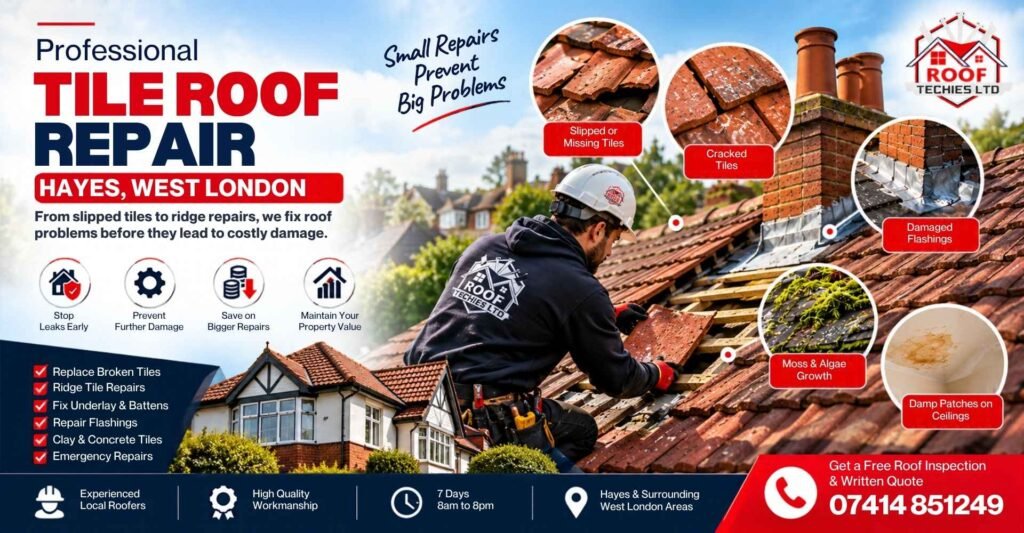
Regular ground-level observation — from across the road with binoculars if necessary — can reveal the most obvious signs of tile roof deterioration before they become serious. Slipped or displaced tiles create a visible break in the regular pattern of the roof covering, particularly obvious on plain tile and interlocking concrete tile roofs. A single slipped tile exposes the felt or membrane beneath and, depending on position and rainfall, can lead to water ingress relatively quickly.
Broken tiles are most commonly caused by impact — fallen tree branches, aerial installation, or foot traffic — and are immediately visible as a gap or fragment. A broken tile should be replaced promptly: leaving a broken tile in place allows UV degradation of the felt beneath and, in winter, water ingress and potential freezing within the roof structure.
Ridge tile failure is one of the most common sources of serious water ingress on West London tiled roofs. Ridge tiles are bedded and pointed in mortar, and that mortar is subjected to the highest levels of freeze-thaw cycling and wind on the entire roof. As the mortar deteriorates, ridge tiles lift, crack, and in severe cases fall — creating a significant hazard to people and vehicles below as well as a major leak point at the apex of the roof.
Granule loss and surface spalling on concrete tiles creates a rough, sandy-textured surface that sheds granules into the gutters. Finding a significant volume of grey sandy residue in your gutters after rain is a clear indicator that concrete tiles are deteriorating at the surface.
Ridge tile repair — why it matters more than homeowners realise
Failed ridge mortar bedding is arguably the most common and most dangerous maintenance failure on West London tiled roofs, yet it is frequently underestimated. A loose ridge tile on a two-storey property can weigh five to eight kilograms. When dislodged by wind — something that becomes increasingly likely as the mortar erodes — it can fall vertically or roll down the roof slope before landing. The consequences for anyone or anything in the path of a falling ridge tile are severe.
Beyond the safety risk, failed ridge tiles create a direct water entry point at the very apex of the roof, where the two main slopes meet. Water entering here runs straight down through the insulation and ceiling below, and the damage can be extensive before it is noticed if the loft is not regularly inspected.
Ridge tiles can be re-bedded and re-pointed at relatively modest cost — typically £300 to £800 for a standard semi-detached property in West London depending on the number of ridge tiles and whether a hip end requires attention as well. Ignoring failed ridges costs significantly more in water damage and emergency call-out fees. We recommend that any property with a tiled roof more than twenty years old has its ridge inspected every five years.
Tile roof repair vs replacement — making the right decision
The decision between repair and replacement for a West London tiled roof depends on the proportion of tiles affected, the age and material of the tiles, the condition of the underlying battens and felt, and the homeowner’s long-term plans for the property.
If fewer than 10–15% of the tiles on the roof are broken, slipped, or spalling, and the roof is less than 30 years old (for concrete) or less than 60 years old (for clay), targeted tile repair combined with ridge re-bedding and gutter clearance is usually the most cost-effective approach. A good roofer can match replacement tiles to the existing roof profile in most cases, and a well-executed repair on a concrete tile roof extends its useful life by ten to fifteen years.
When a concrete tile roof has aged beyond 35–40 years, when more than 20% of tiles are affected, or when the felt beneath the battens has failed and become brittle and perforated, a full replacement provides better value. Stripping and re-roofing with new concrete or clay tiles allows the battens, felt, and fixings to be renewed along with the tile covering, providing a comprehensive upgrade rather than successive repairs on an increasingly marginal roof.
For homeowners planning to sell within five years, a full re-roof with quality clay or concrete tiles is an investment that significantly reduces the scope for downward negotiation from buyers whose surveyor flags the roof condition. For homeowners planning to stay, the same investment provides peace of mind and dramatically reduced maintenance expenditure for the following twenty to forty years.
Tile roof installation and replacement costs in West London — 2026
A full tile roof replacement on a typical three-bedroom semi-detached property in West London (approximately 55–75m² of roof area) costs between £7,500 and £15,000 in 2026, depending on the tile specification, scaffold requirements, and whether valley or hip tiles require particular attention.
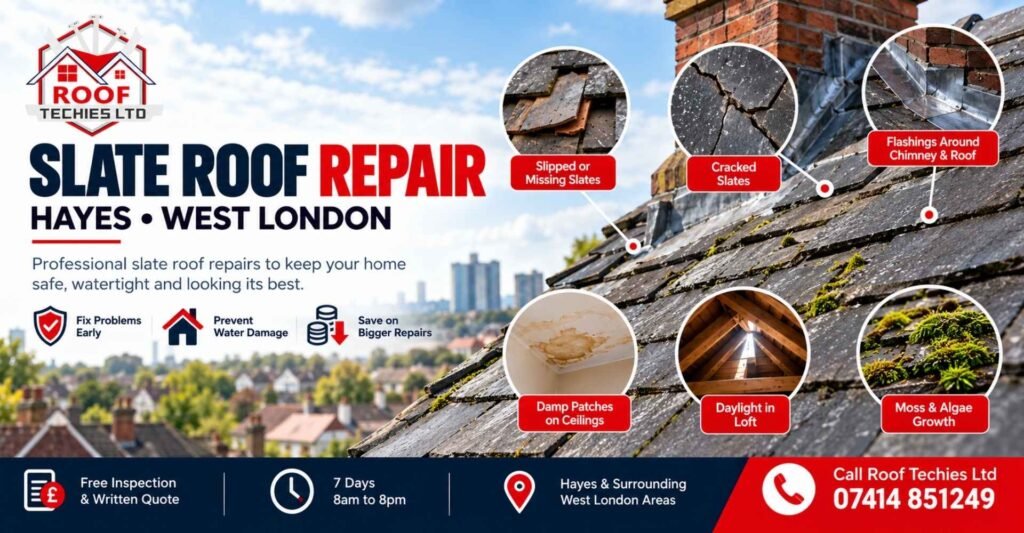
Concrete interlocking tile re-roofs sit at the lower end of this range. A clay plain tile or clay pantile re-roof — which requires more tiles per square metre and more labour time to install — sits at the upper end. Welsh slate re-roofs on the same footprint would typically be priced between £12,000 and £20,000, reflecting the material cost of quality slate.
Individual tile repairs — replacing five to twenty broken or slipped tiles — typically cost between £150 and £450 depending on access and tile matching. Ridge re-bedding for a full roof ridge run costs £300 to £700 for a standard semi-detached. These smaller repairs are worth commissioning proactively rather than waiting for water ingress to appear internally.
Frequently asked questions — tile roofing West London
Q: Can I walk on my tiled roof?
Walking directly on roof tiles is not recommended — it risks cracking tiles and dislodging adjacent tiles. Contractors use roof ladders and crawl boards to distribute weight across multiple tiles when access is required. Homeowners who attempt to inspect or repair tiles by walking on the roof often cause more damage than they fix.
Q: How do I match replacement tiles to my existing roof?
Tile manufacturers change their product ranges regularly, so matching tiles can be challenging on older roofs. An experienced roofing contractor will have access to reclaimed tile suppliers and can often find tiles that are a close or exact match. For older clay tile roofs, reclaimed tiles from the same era can be sourced from salvage yards.
Q: Does my insurance cover roof tile repair?
Storm damage — tiles displaced by high winds during a named storm — is typically covered by home insurance. Wear and tear, gradual deterioration, and maintenance issues are generally excluded. If tiles have been displaced following an identifiable storm event, contact your insurer before authorising any non-emergency repair work.
Q: How can I tell if my roof felt has failed?
Signs of failed roof felt include light visible from the loft on a bright day (indicating the felt is perforated), insulation that is persistently damp despite no visible ceiling staining, and a musty smell in the loft during or after rain. If felt failure is confirmed, a full re-roof is typically required rather than a patch repair.